
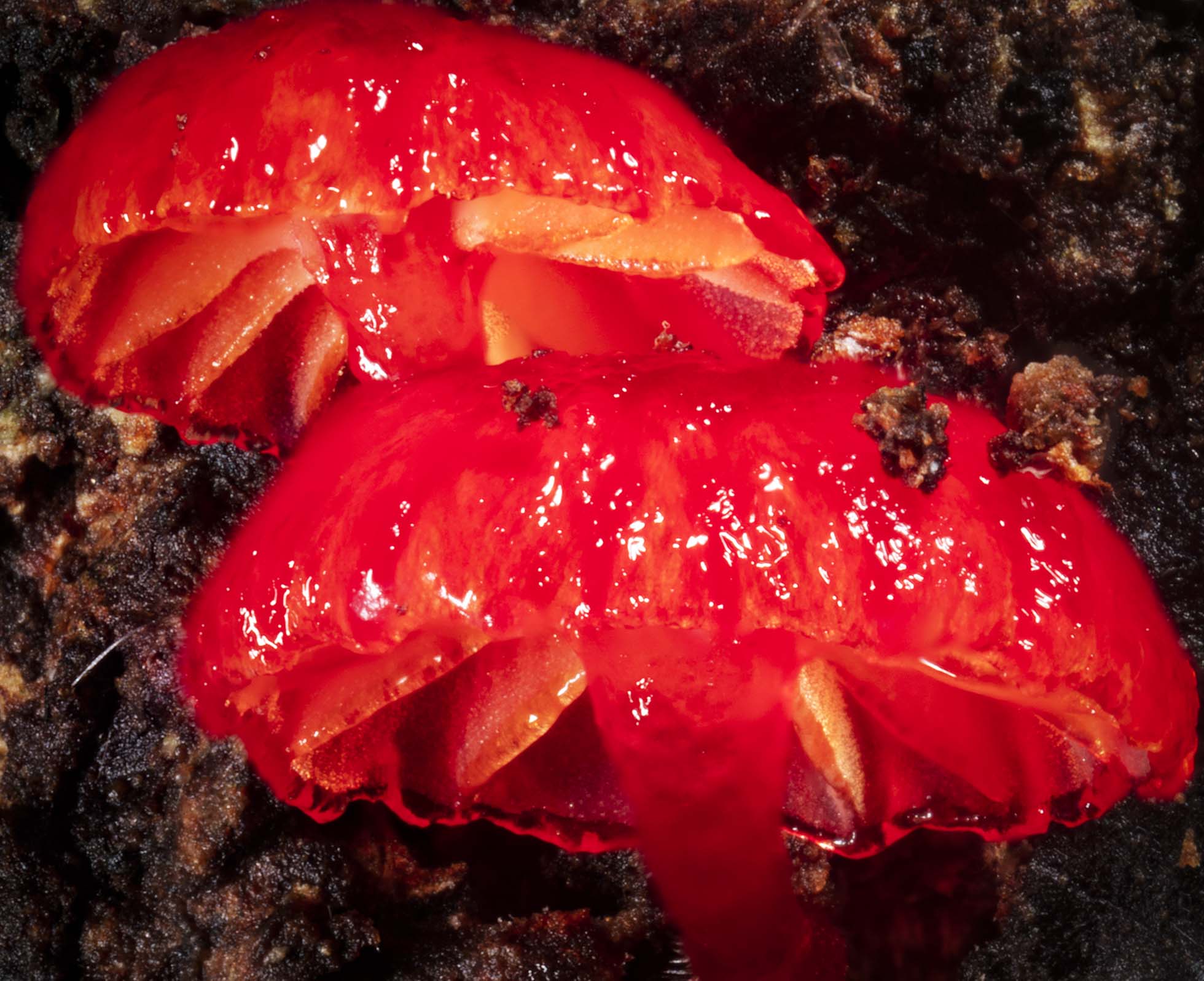
Daintree Rainforest Camera Trap Project
Cumulative sightings across 2021, 2022, 2023, 2024 & 2025:
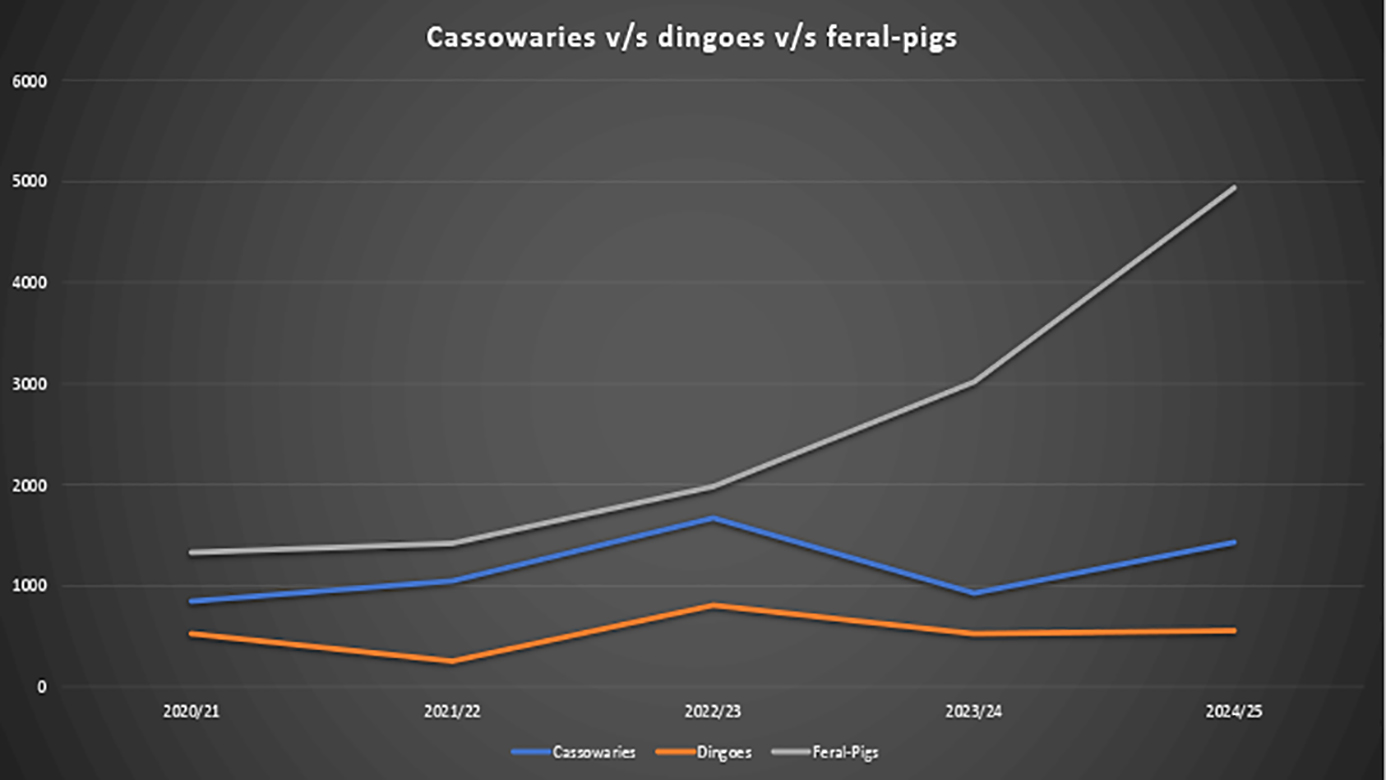
Overlay of cassowary sightings between 2020 – 2025:
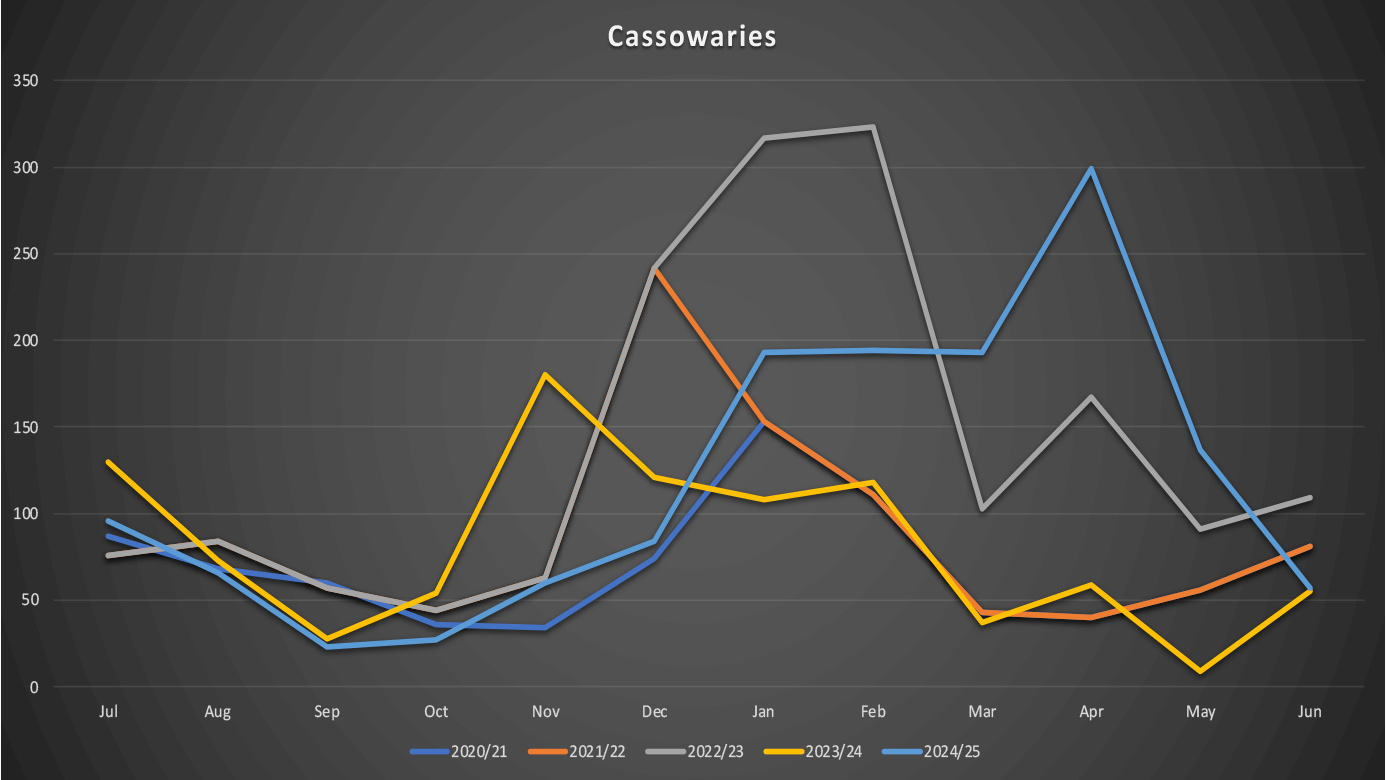
Overlay of dingo sightings between 2020 – 2025:
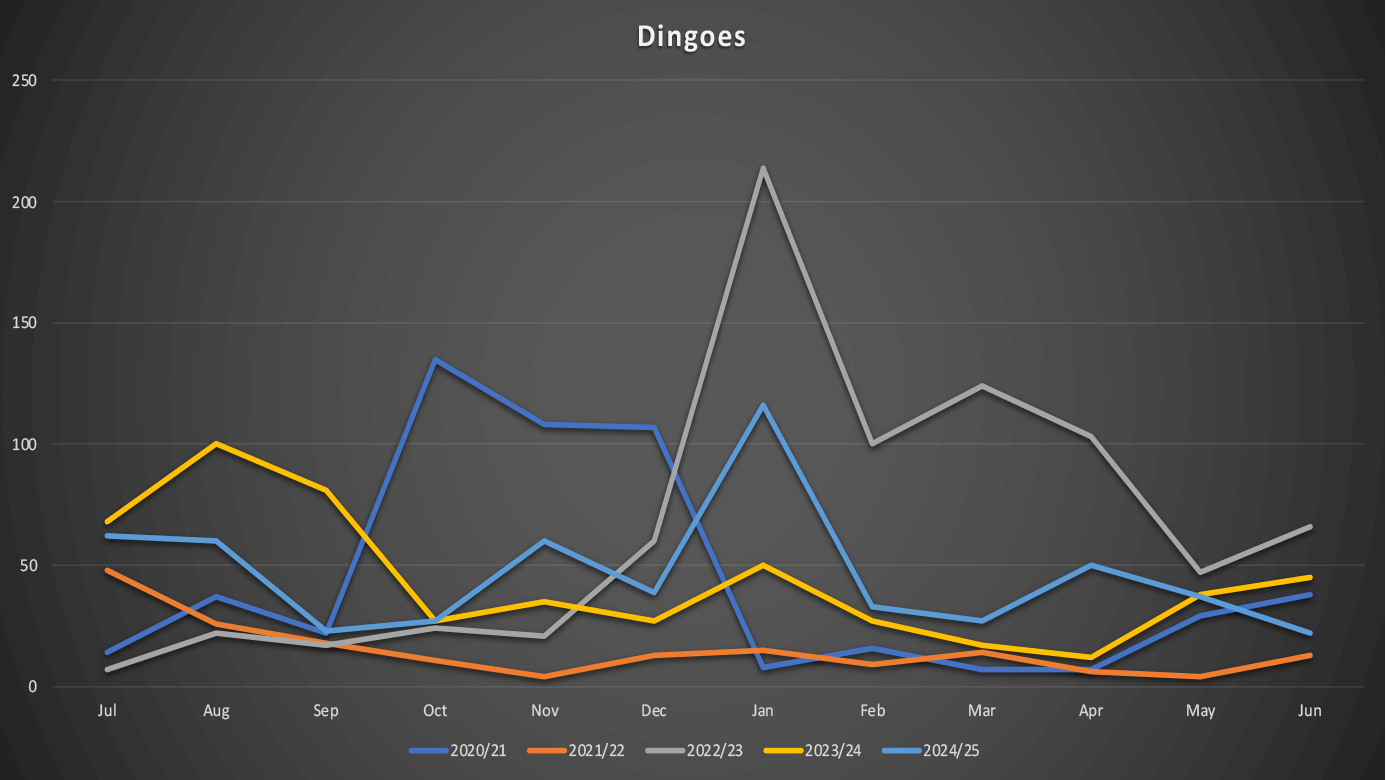
Overlay of feral-pig sightings between 2020 – 2025:
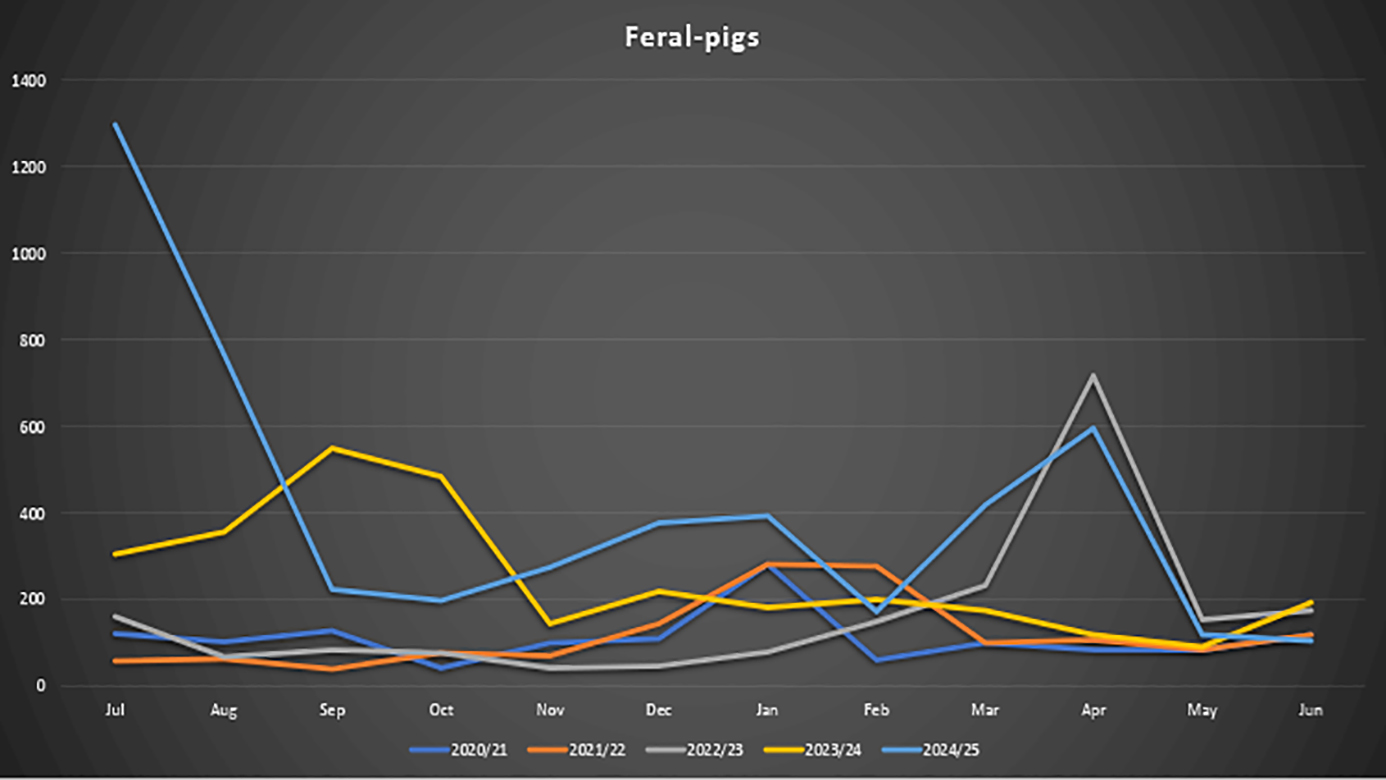
As a keystone species sustaining a multitude of dependent symbionts that would all fall with its demise, the Southern Cassowary occupies the highest order of importance for conservation priority. For territorial advantage, cassowaries are the only player in the world’s longest surviving rainforest that step into the spotlight generated by the loss of an upper-story giant, to illuminate their reds and blues and consequently plant trees under canopy openings to fill gaps left by collapsed crowns, restoring structural integrity and maintaining cyclones as replenishing assets rather than catastrophic liabilities. For all their unrivalled importance, cassowaries must be provided with the highest order of protection and Australia must eradicate feral-pigs.
The dismal tide of corruption upon Daintree Rainforest philanthropy
The Foundation has expressed increasing concern for the loss of property after property to a relentless campaign of purportedly Saving the Daintree Rainforest from the threat of development, diminishing a conservation community of its managerial assets.
Registered ‘charities’ from far and wide claiming to conserve and restore parts of the Daintree Lowland Rainforest that are currently excluded from National Park, profess that they are working towards a vision of a re-wilded Daintree rainforest managed by its rightful owners.
The only part of the Daintree Lowland Rainforest that is excluded from National Park is already well and truly regulated for environmental protection, to ensure that any authorised development, subject to providing an appropriate level of economic opportunity for residents, achieves ecological sustainability through the established purpose:
To retain the attraction of the area as a very low-key, largely undeveloped nature-based recreation environment, based on the exploration and appreciation of the natural environment and to ensure that any development that does occur is appropriate and does not place additional pressures on the values of the area.
Also, the bulk of the world-renowned Daintree Rainforest has been quarantined from development since 9th December 1988, within the binding formality of World Heritage-listed Daintree National Park and beyond the boundaries of this surrounding public estate, some of the lawfully established and long-pre-existing freehold property, having long preserved much of its biological diversity and ecological integrity, is also World Heritage-listed and National Heritage-listed for Natural and Indigenous Cultural Heritage protection, whilst others are formally declared Protected Areas under the Nature Conservation Act 1992. Indeed, the entire enclave, has been legislatively protected within the Commonwealth Government’s Environment Protection & Biodiversity Conservation (EPBC) Act 1999 upon the Threatened Ecological Communities List since 26th November 2021.
Whatever skerrick of development capability this minority freehold enclave retains, is subject to both Federal Ministerial approval under the EPBC Act and also State and Local Government approvals, in compliance with QLD’s Planning Act 2016, Biosecurity Act 2014, Local Government Act 2009, Aboriginal Cultural Heritage Act 2003, Vegetation Management Act 1999, Wet Tropics World Heritage Protection and Management Act 1993 and Nature Conservation Act 1992. All landholders throughout this enclave, without exception, are legislatively required to protect their property’s natural and cultural heritage from activity that may cause harm.
Under this most stringent and prescriptive regulatory regime, the people and communities of the Cape Tribulation and Daintree Coast Local Plan Area are not only required to protect the environment, of which they themselves are legislated parts, but their capacity to do so and their fundamental right to subsist from fulfilling this requirement, relies upon the income-earning value of their environmental assets and also the quality of their ongoing care, to sustain the sole source of conservation-cost-recovery from genuine ecotourism.
No matter how valuable, vulnerable or renowned the greater Daintree Rainforest is, nor how ‘special’ or coveted the privately-held portion, the very existence of the freehold enclave was lawfully established by the State of Queensland eighty-six-years before surrounding National Park was first gazetted in 1980 and it is not within the rights or entitlements of any non-government entity to attempt to unlawfully procure its alteration.
ACNC Governance Standard 1
Registered charities must demonstrate that they work towards their charitable purpose.
Maligning the lawfully established Cape Tribulation and Daintree Coast community, as if it should never have existed and condemning its landholders as implicitly wrongful, to drive a multi-million-dollar fund-raising campaign that dismantles the community, property by property, is prejudicial, invasive and subversive. The environmental values held within targeted freehold properties are an undeniable testament to the preceding landholders’ protective competencies, which required no charity to achieve beyond that which the landholder had already given. Greatly overstating environmental importance and/or vulnerability to unrecoverable harm, to fan the flames of public outrage and subsequently enrich fund-raising largesse, exacerbates the impropriety of uncharitable dishonesty.
Imputing that Cape Tribulation and Daintree Coast landholders are in any way lacking in rightfulness or legitimacy is as dishonest, offensive and uncharitable as inferring that conservation and restoration are contingent upon those landholders selling their properties to allow the environment to be protected forever by rightful owners. Indeed, it would be far more charitable and cost-effective to ensure that the millions of dollars donated for conservation and restoration of these properties gets to the incumbent landholders, leaving the environmental asset of community custodianship intact.
On a point of principle, if the average purchase-price of freehold land within the Cape Tribulation and Daintree Coast Local Plan Area was conservatively estimated at $50,000-per-property, ownership of the full enclave would have cost $56.8-million. No other investor or government-funded ‘rescue’ program or even the full-collection of invasive external ‘charities’ have come close to the economic contribution of the local community, collectively carrying the burden of cost for property ownership, management and protection, as well as maintaining rates payments for governance and regulation. Community vigilance provides the eyes, ears, voices and intelligence that tend to the area’s passionate and expert stewardship, twenty-four-hours-a-day, seven-days-per-week, month after month, year after year and without any cost to the taxpayer. The contiguous tenure advantage of freehold-title provides the custodial community with the legal right to exclude trespass and a permanent protective presence regulates the uninformed enthusiasms of the half-million-or-so visitors per-year to properly engage with the world-renowned Daintree Rainforest environment.
There is simply no more strident, nor cost-effective expression of environmental charity than that which is discharged by the custodial community throughout this enclave. Any external agency that claims to charitably save the environment by seeking to displace people and communities from coveted property, will only ever be usurpatory and harmful, as it degrades the quantity, quality and contiguousness of Cape Tribulation and Daintree Coast environmental capital, compromises the integrity of community stewardship and erodes the higher order of environmental charity and conservation cost-recovery-potential.
With the bulk of fund-raising appearing to be derived through crowdfunding, manipulation almost certainly provokes the willingness of both prospective donors to donate and also besieged landholders to relinquish ownership. Falsely advertising that properties with globally important environmental values were wrongfully excluded from National Park, but can be saved along with endangered and iconic species like Southern Cassowaries and Bennett’s Tree Kangaroos, almost certainly cajoles members of the target audience into desiring what they may previously have lacked reason to want, inciting an inflamed emotional response, whilst perpetuating dishonest standards of success, with reiterating algorithms and other social networking mechanisms, such as ‘likes’, ‘shares’, and ‘comments’, undoubtedly exerting leverage upon any such manipulation.
ACNC Governance Standard 3
Charities must not commit a serious offence (such as fraud) under any Australian law. Dishonestly overstating protective urgency of extraordinary environmental values, which belong to the holder of coveted property, may well amass exorbitant revenue from donations harvested from unattainable promises of protecting critical habitat for the endangered Southern Cassowary, Bennett’s Tree Kangaroo and several endangered primitive flowering plants, but the benefits and/or advantages, pecuniary or otherwise, derived from such dishonesty, inflicts cumulative losses upon the people and communities of the Cape Tribulation and Daintree Coast Local Plan Area.
The Southern Cassowary is an Endangered Species, both federally and also under Queensland law. Bennett’s tree-kangaroo is classified as ‘near threatened’ upon the IUCN Red-list and all plant species with a declared conservation status remain legislatively declared regardless of a property’s change of ownership. Promising that habitat values in urgent need of protection will henceforth be ‘protected forever’ is dishonest, whereas gaining a benefit or advantage, pecuniary or otherwise from such dishonesty, aligns with the QLD Criminal Code definition of fraud.
Exaggerating environmental vulnerability for urgent acquisition of coveted property because it possesses desirable attributes that belong to another, is inherently fraudulent. Indeed, the very existence of the coveted attributes is evidence of the incumbent property-owner’s successful protection. The property remains the same as it was when acquired and if protected forever upon acquisition, so it must have been protected upon disposal and it is fraudulent to assert or infer otherwise.
Gross misrepresentation of environmental values and landownership within the Cape Tribulation and Daintree Coast Local Plan Area clearly amasses revenue, but when such a yield through dishonesty exceeds $5,000, the QLD Criminal Code informs that the offender is liable to an increased imprisonment for 10-years.
When landholders are besieged by a relentless barrage of misrepresentations and public criticisms, contending that environmental treasures under their care are at grave risk and can only be protected by surrendering ownership to the abundantly-funded and publicly vocal naysayer, at what point does the disposal of property become coercive and how is sale-price influenced by the relentless torrent of public denigration?
Campaigning for the ‘protection’ of extraordinary natural values that extend way beyond the borders of coveted properties and across the much larger and world-renowned Daintree Rainforest, transgresses beyond the entitlements of innocent intention, as defined within Section 45 of the QLD Criminal Code. Broadcasting that the ‘world’s oldest rainforest’ is for sale and implying that it is wholly and solely owned by private-landholders, whilst inferring that the State has historically erred in its lawful establishment of the Cape Tribulation and Daintree Coast Local Plan Area, where it rightfully should have been declared National Park, robbing Sovereign subjects of their greater entitlements, incites discontent and/or disaffection amongst the Sovereign’s subjects of the State.
The relentless campaign of implied residential impropriety, brandishing the rarity, primitiveness, endemicity and irreplaceability of the Cape Tribulation and Daintree Coast Local Plan Area’s environmental values, including critical habitat for the endangered Southern Cassowary and Bennett’s Tree Kangaroo and several endangered primitive flowering plants, as an urgent call-to-action, whilst decrying that these values are in crucial need of protection from current ownership, uncharitably foments feelings of ill‑will or enmity towards those people and communities of the Cape Tribulation and Daintree Coast Local Plan Area, threatening the peace, order and good governance of this lawfully established portion of the State. Purporting to conserve and restore parts of the Daintree Lowland Rainforest that are currently excluded from the protections of national park status, so it can be owned and managed by Traditional Owners, overtly promotes an expression of restored Indigenous justice, which manifests onto the incumbent landholders with vilifying racial and cultural discrimination.
The people and communities of the Cape Tribulation and Daintree Coast Local Plan Area hold passionate views about the importance of their environment and also restored Indigenous rights, but the very public and uncharitable way that their property-ownership is derided as unprotected and in urgent need of saving, with restored Indigenous ownership upheld as ‘protected forever’, incites hatred towards, serious contempt for, or severe ridicule of the existing landowners, further agitating feelings of ill‑will or hostility.
Any expression of concern for latent environmental vulnerability of freehold properties from within the Cape Tribulation and Daintree Coast Local Plan Area, is arguably seditious, as it is all well and truly protected via federal declaration as an Endangered Ecosystem Community under the EPBC Act 1999, as well as the most rigorous legislative and regulatory compliance requirements for environmental protection found anywhere in the world, but with a permanent, self-funded and self-motivated residential custodianship in situ. Also, if there were any legitimate concerns for higher protection, the State is well equipped with legislative instruments, including Compulsory Declaration of a Nature Refuge, which provides the same legislative protection of National Parks, but also protects the landholder’s interests from being injuriously affected by a restriction or prohibition imposed under the declaration or regulation on the land-holder’s existing use of the land, whereupon the land-holder is entitled to be paid by the State the reasonable compensation because of the restriction or prohibition that is agreed between the State and the land-holder or, failing agreement, decided by the Land Court.
The reputation and property of the Cape Tribulation and Daintree Coast Local Plan Area is heavily protected by a passionate custodial community under binding regulation. The people and communities that are constituent parts of the legal definition of ‘environment’ are also well-aware that their long-term economic, social, environmental and cultural well-being is inextricably intertwined with the care and protection of their income-earning ecological assets.
Environmental Advocacy
DAINTREE FERRY QUESTIONS
The Foundation has respectfully asked Council to amend the ferry policies and practices that have historically inflicted profound damage upon the residential and business communities within the attraction, by emphasising that the most comprehensive policy framework and associated data-set for ferry-operations and impacts ever established, the Daintree Futures Study (DFS) 2000 held as its primary objectives:
- conservation of the Daintree’s outstanding biodiversity, natural and cultural values (especially World Heritage values) for current and future generations;
- provision of appropriate services for residents; &
- provision of appropriate management regimes and infrastructure to support a high-quality tourism industry which maximises returns to the local community.
The DFS verified that there is a significant issue of competitive equity between the local community’s provision and maintenance of nature-based tourism facilities and those on public lands and a need to adjust ferry charges to achieve a better balance between the costs paid by public site users and those who visit private destinations. Varying ferry prices and management can influence equity to local residents and businesses, as well as collecting user-fees for environmental management and providing and maintaining visitor facilities and infrastructure services where user-pays at individual sites is inefficient. Against the acknowledged importance of providing ferry priority to travellers, overnight stays and group tours that support the local community’s conservation economy, the DFS recommended that the ferry pricing structure should be changed to:
- Self-drive: $20 per vehicle (30-day pass non-transferable)
- Transfer buses: $4 per person
- Tour buses: $4 per person
- Residents: Current pricing retained.
Council asserts that the Daintree Ferry subsidises general rates by providing a revenue stream. In 2000. the DFS established that the net revenue raised through ferry fees far exceeded the operating costs paid to the contractor by around $500,000 per annum. In 2020, Council reported that the Daintree Ferry generated revenue for Council beyond operational and associated costs, netting an estimated $1.15-million annually. The ferry-fee for a single vehicle crossing has increased by 364% since 2000, but none of this revenue has supported the DFS objectives of conservation, residential service-provision or visitor management and infrastructure within the destination. Indeed, such expenditures are essentially precluded by the DAINTREE FERRY REVENUE GENERAL POLICY, which is constrained in its upper limit at four million dollars, fed from the ferry’s annual surplus by a maximum of five hundred thousand dollars per-year, whilst the major portion runs into Council’s operational fund.
This surplus from over-charging on the ferry meets the definition of a tax, characterised by a compulsory extracture of money by a public authority for public purposes, which is not exclusively a payment for ferry-transportation services rendered. In consideration of the 2005 decision of the Supreme Court of Queensland by Justice Moynihan in Douglas Shire Council v Queensland Ombudsman, the relevant principle was that a local government authority cannot impose an additional fee on a service or facility with the specific intention of directing funds towards another particular purpose that is unrelated to the service or facility being charged. In this case, the Court ruled that the portion of the accrued ferry-fees, which was not “for” the provision of the ferry service, was hence not authorised within the power given by s 262.3(c) of the Local Government Act 2009.
Since World Heritage-listing on 9th December 1988, when the Daintree Rainforest community held a veritable monopoly of tourism access and management potential between the road network and the famed Daintree Rainforest, about forty-percent of community-lands have been commandeered unto public ownership, with boardwalks and visitor facilities funded upon strategically acquired properties, seizing tourism advantage away from the local community onto these heavily subsidised facilities. Commercial Activity Permits were almost exclusively restricted to day-tour operators out of the regional accommodation centres, whilst the Wet Tropics Management Authority (WTMA) implemented a policy of re-directing tourism beyond sustainable levels to appropriate areas south of the Daintree River, with tens-of-millions-of-taxpayer-dollars invested into competing travel destinations and experiences to drive this re-direction policy towards fruition, whilst ferry-fees for entry into the area skyrocketed.
To help appreciate the magnitude of injurious impact, Councillors and staff may imagine the reciprocal scenario if a $51 per-vehicle levy were imposed for entry into and exit from Port Douglas. On top of such an extracture, if forty-percent of Port Douglas prime tourism real-estate were acquired and fitted with tourism accommodation, food and beverage, to compete directly with the private-sector, but subsidised for the illusion of free-entry, travellers would be hard-pressed to justify patronising private properties for their relatively exorbitant expense.
Major works for widening approaches to allow dual-lane loading onto a four-lane ferry, will undoubtedly incur substantial costs, as will the impost of additional staffing for safe management of the dual-lane-loading, all of which fall under the cost-recovery entitlements currently authorised within the DAINTREE FERRY REVENUE GENERAL POLICY, which will inevitably increase the burden of expense for visitor-access across the Daintree River and subsequently into the business community within the destination with compounding injurious affect.
Douglas Shire constituents have been advised that design for these major upgrades was informed by GEO technical investigation, Flora/Fauna survey, Protected Plant survey, Ecological Assessment, Enviro-Management Plan, Cultural Heritage assessment, Hydrographic survey, Flood Modelling report & Preparation of Development Application, but not from any socio-economic impact assessment upon the residents and business community within the attraction, despite the history of profound injurious affect.
Minimising ferry-fees upon travellers pre-committed to patronising local ecotourism businesses, whilst increasing fees for travellers that are intent on by-passing local enterprises in favour of publicly-funded National Park facilities and services, will swing tourism in a supportive direction of the aforementioned DFS objectives. However, for the influence of the big players within regional tourism industry that may be major beneficiaries of the existing policy arrangement, it would be prudent for Council to engage an expert consultancy in socio-economic analysis to forensically determine the magnitude of historic impact and the potential for optimised improvement, so that this next phase in ferry-development does not inadvertently fall into this deeply inscribed rut of historical wrongdoing.
Within the existing policy framework, Council could exculpate itself from any unintended wrongdoing by amending the DAINTREE FERRY REVENUE GENERAL POLICY to ensure that every dollar of surplus ferry funds goes into the reserve, that the upper limit is removed and the aforementioned DFS objectives are included as legitimate aspects of the Daintree Gateway Master Plan’s purpose of improving the experience for visitors and increasing economic benefit for local communities and businesses within the Daintree-Cape Tribulation area.
Backward step for freehold conservation
Conservation constraints invoked across freehold properties, in ways typically associated with public-reserves, adds economic challenge to landholder obligations, particularly since public lands do not pay any rates to Local Government whatsoever, but are also fully-subsidised to provide tourism with the illusion of free and unrestricted access. Putting this disparity into perspective, freehold land in Queensland is valued 75.6-times higher than public land gazetted for conservation.
For many years, Douglas Shire Council maintained pro-active support of freehold landholders through a Rates Incentive for Conservation Policy, with up to 50% rate-relief for inscribing a conservation covenant upon the property title, a policy Council rescinded on 24th June 2025, saving $32,000 per-annum. This amounts to a measly 0.5% of the tourism revenue taken off the ferry annually. Landholders, however, unceremoniously severed from the rates incentive, will now have to pay double the rates payments of properties they had encumbered in good faith with a conservation covenant to avail themselves of the rate incentive that Douglas Shire Council offered when the policy was first adopted.
2023-24 was clearly dedicated to recovery and resilience from damage caused by December 2023’s Tropical Cyclone Jasper. Despite eligibility and the onerous impost on time, the Foundation was unsuccessful in its application for access improvement from the $10-million Building Bush Tourism (BBT) Fund, which offered financial support to not-for-profit organisations to deliver new or enhanced tourism related infrastructure, to attract and grow both regional participation and visitors to the region.
Daintree Rainforest Fund
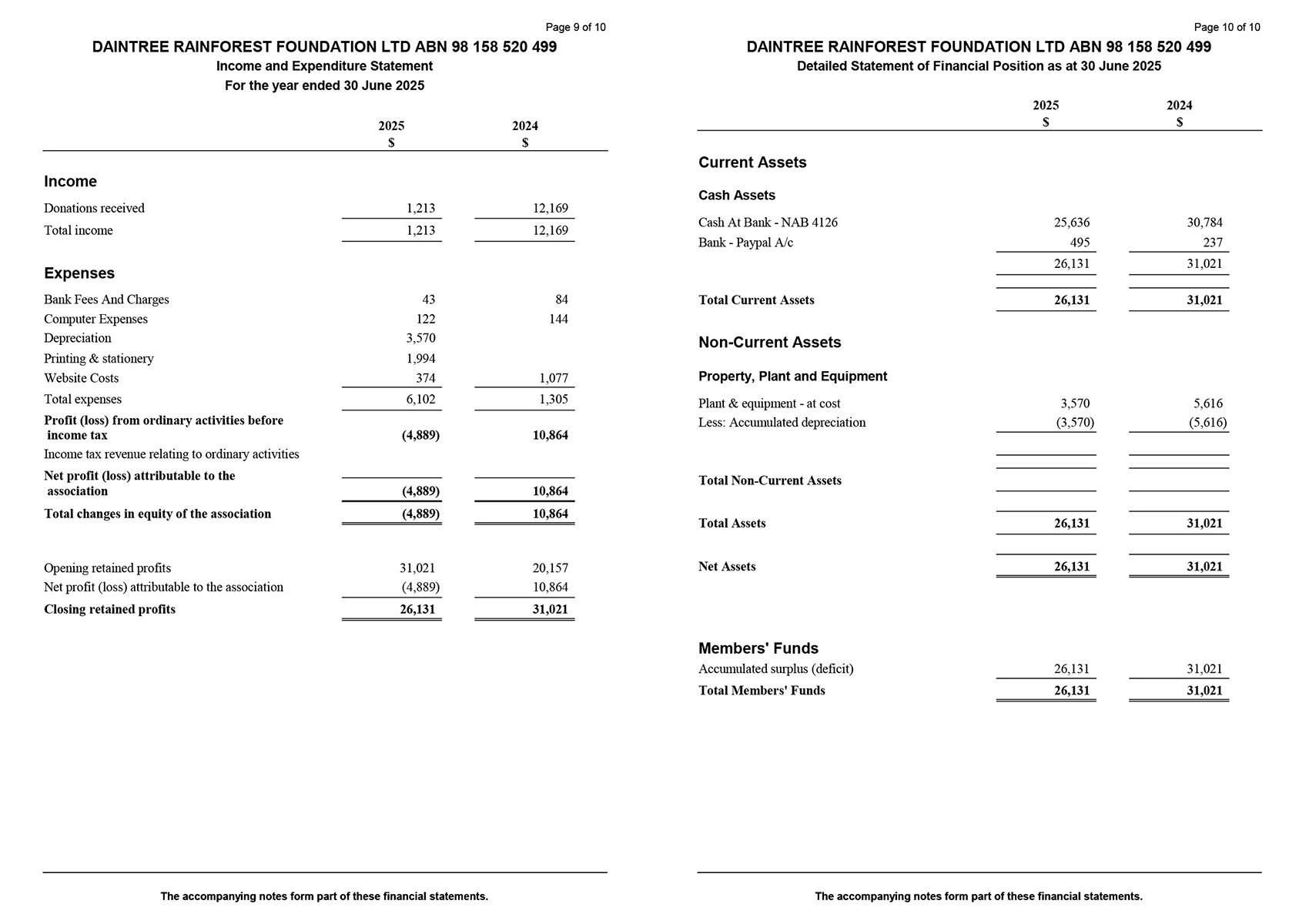
On behalf of the Foundation, I hereby thank the generous contributors to the Daintree Rainforest Fund and also the directors, for their enthusiasm, dedication and all the various contributions that have brought the Daintree Rainforest Foundation Ltd., successfully to its tenth Annual General Meeting.
Neil Hewett – Chairperson
Daintree Rainforest Foundation Ltd has been registered by the Australian Charities and Not-for-profits Commission and successfully entered onto the Register of Environmental Organisations. Donations made to the Daintree Rainforest Fund support Daintree Rainforest community custodianship and are eligible for a tax deduction under the Income Tax Assessment Act 1997.